Tongits Rules: Melds, Sapaw, Calling Draw, Fighting and Scoring
Welcome bonus for new players + fast crypto payouts. Just helping a brother out.
18+/21+. Crypto only. Ad: we may earn a commission. Play responsibly. October 2026
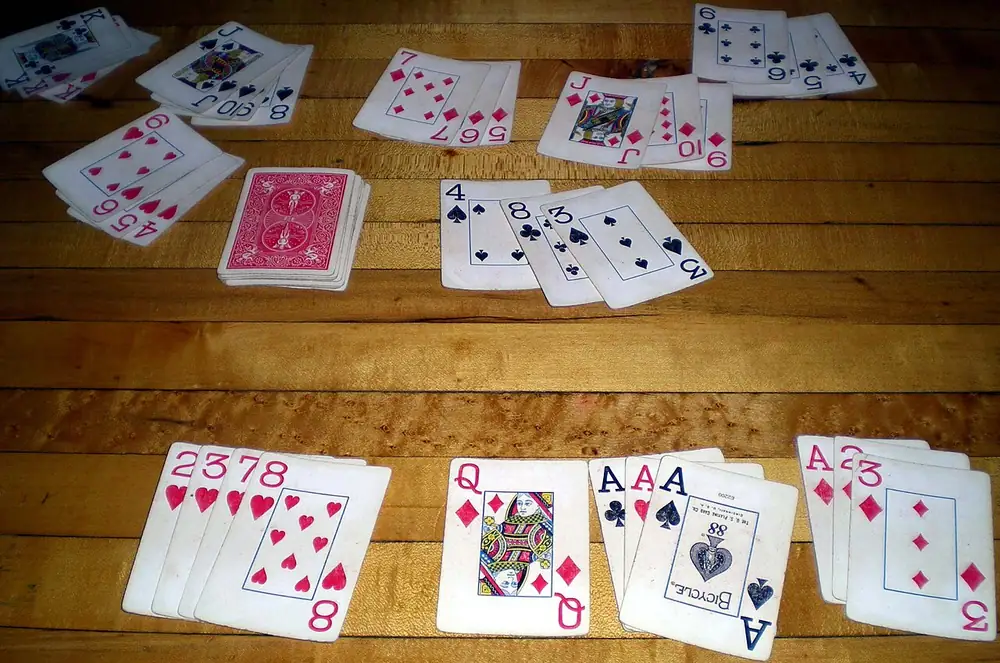
Tongits is the Philippines' national rummy game: three players, one deck, and a race to either empty your hand or end the round holding the fewest points. What makes it uniquely Filipino is the mix of sapaw (laying off on anyone's melds), calling Draw, and the threat of being burned.
This page is the full rulebook. For a slower, step-by-step first game in Tagalog, see paano maglaro ng Tongits. For card and table games online, see our online casino Philippines guide.
18+/21+. Crypto only. Ad: we may earn a commission. Play responsibly. October 2026
Setup
- Players: exactly three.
- Deck: standard 52 cards, no jokers.
- Deal: counter-clockwise, one at a time. The dealer gets 13 cards; the other two get 12 each.
- Stock: the remaining 15 cards go face down in the centre.
- Dealer: chosen randomly for the first hand; afterwards, the winner of the previous hand deals.
Card values
| Card | Points |
|---|---|
| Ace | 1 |
| 2 to 10 | Face value |
| Jack, Queen, King | 10 |
Points matter only for cards left unmelded in your hand (deadwood). In sequences, Ace is low: A-2-3 is a run, but Q-K-A is not.
Melds (bahay)
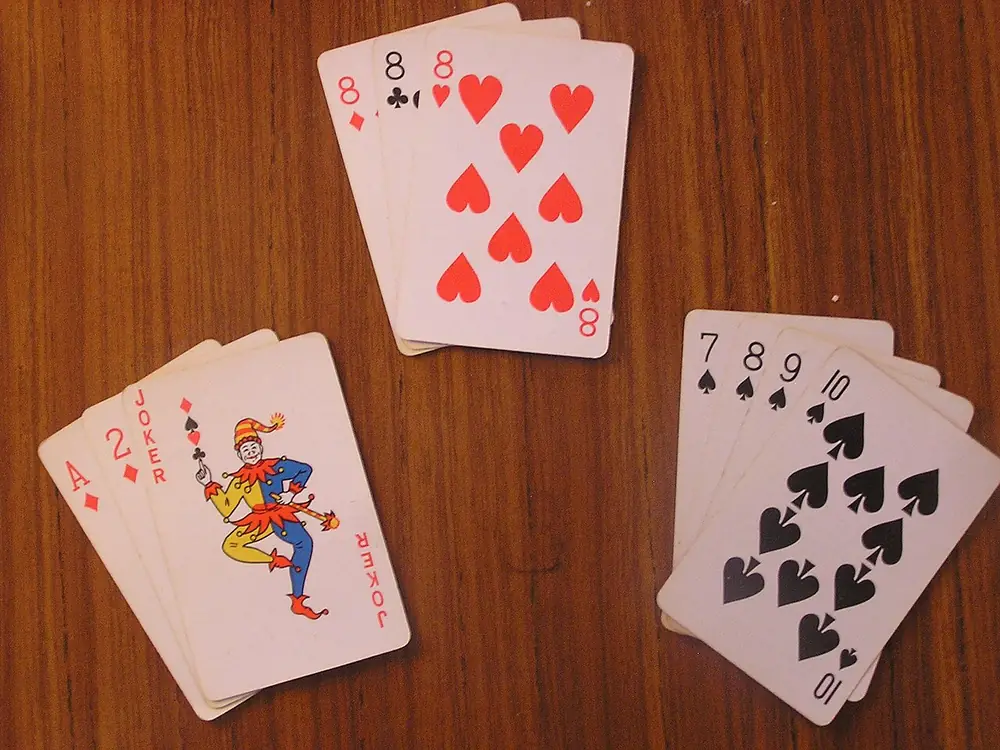
- Set: three or four cards of the same rank, e.g. 7♣ 7♥ 7♦.
- Run: three or more consecutive cards of the same suit, e.g. 4♠ 5♠ 6♠ 7♠.
Mixed-suit sequences don't count. A card can belong to only one meld.
The turn sequence
The dealer starts by discarding one card without drawing (they already hold 13). After that, play passes counter-clockwise, and each turn has up to four steps:
- Draw. Take the top card of the stock, or take the top card of the discard pile, but only if you immediately use it in a meld that you expose right away.
- Expose melds (optional). Lay any sets or runs from your hand face up in front of you.
- Sapaw (optional). Add cards to any exposed meld on the table, yours or an opponent's. For example, add the fourth 7 to someone's set of 7s, or 8♠ to a 5-6-7♠ run.
- Discard. End your turn by placing one card face up on the discard pile.
Sapaw and the Draw block
Sapaw is the defining tactic. It gets rid of your cards without building your own meld, and it has a second effect: if someone lays off on your meld, you can't call Draw on your next turn. Many rule sets also block you from calling Draw if you laid off on your own melds in your previous turn. Players use sapaw on an opponent's melds specifically to stop them calling Draw at a dangerous moment.
Three ways a round ends
1. Tongits
If you get rid of every card in your hand through melds and sapaw, you call Tongits and win immediately. This usually pays the most. In most groups, the final card can be melded or laid off rather than discarded.
2. Calling Draw
At the start of your turn, before drawing, you may call Draw if:
- you have exposed at least one meld during the round, and
- you aren't blocked by a recent sapaw.
Each opponent then chooses to fold (concede) or fight (challenge). Only players who have exposed at least one meld may fight. Fighters reveal their hands and everyone counts deadwood. The lowest total wins. Ties go to the challenger, so the caller must be strictly lowest. If both opponents fold, the caller wins without showing. If neither opponent has opened a meld, nobody can fight and the caller wins.
3. Stock runs out
If the last stock card is drawn and the round hasn't ended, players compare deadwood. The lowest total among players who exposed at least one meld wins.
Fight or fold?
When someone calls Draw, count your deadwood honestly. The caller usually has a low total, often under 10, because calling with a high count invites a fight. If your count is clearly higher, fold and limit the damage, since losing a fight often costs extra. Fight when your count is equal to or lower than what the caller is likely holding, remembering that a tie goes to you as the challenger. Watching how many cards the caller still holds is a good clue: two small cards could be as few as 2 points.
Burned (sunog)
A player who hasn't exposed any meld by the end of the round is burned. They can't win on points, can't fight a Draw, and usually pay extra. Avoiding sunog is why players often expose a meld early even when they'd like to keep it hidden. Some groups recognise "secret" melds, such as a hidden set of four, that let a player fight but not call; check local rules.
Scoring and payouts
Payouts vary by group. A common structure, in chips or pesos:
- Base win: each loser pays the winner a fixed amount.
- Tongits: a higher payment, often double or more.
- Winning a fight: extra from each player who fought and lost.
- Burned: burned players pay extra.
- Bonuses: for holding a hidden four-of-a-kind, aces, or consecutive wins, depending on the table.
- Pot/jackpot: some groups feed a pot each hand that's won by Tongits or by a set number of consecutive wins.
Agree on the payout list before the first deal and write it down. Most disputes come from payouts, not play.
18+/21+. Crypto only. Ad: we may earn a commission. Play responsibly. October 2026
Worked example
Ana deals (13 cards), Ben and Carla have 12 each. Ana discards K♦. Ben's turn: he can't use the K♦, so he draws from the stock and exposes 3♥ 4♥ 5♥, then discards J♣. Carla takes the J♣ because she holds J♠ J♦ and exposes the set right away, then discards 9♦. Ana draws, lays the 6♥ off on Ben's run (sapaw), and discards. Because Ana laid off on Ben's meld, Ben can't call Draw on his next turn.
A few turns later, Carla has exposed melds and only 4♣ and 2♦ left in hand: 6 points. At the start of her turn she calls Draw. Ben (opened, 9 points deadwood) fights; Ana (opened, 6 points) also fights. Ana ties Carla, and ties go to the challenger, so Ana wins.
How long a round lasts
With only 15 cards in the stock, a round where nobody takes discards lasts at most 15 draws, about five per player. Every discard taken stretches it a little. That short clock is why tempo matters: you rarely have time to wait for the perfect card, and dumping high deadwood early is so important.
Counting deadwood: a quick example
Your unmelded cards at a Draw: K♠, 9♦, 3♣, A♥. That's 10 + 9 + 3 + 1 = 23 points. If you could lay the 9♦ off on an exposed 6-7-8♦ run before the Draw, you'd drop to 14. Every high card you shed before someone calls is worth more than any low card.
Common house-rule variations
- Whether you may take the discard to lay off (sapaw) rather than to make a new meld; usually not.
- Whether the Draw block applies after laying off on your own melds.
- Tie-break between two challengers (often the player nearest the caller in turn order).
- Special "secret" melds and what they allow.
- Payout amounts for Tongits, fights, burns and bonuses.
- Whether the round winner or the next player deals.
Core strategy
- Dump high cards early. Unmelded face cards cost 10 points each if someone calls Draw.
- Open at least one meld early to avoid sunog and gain the right to fight.
- Watch discards. If two 8s are gone, your pair of 8s won't become a set.
- Use sapaw defensively to block an opponent who looks ready to call Draw.
- Call Draw when you're confident you're strictly lowest. Remember ties lose for the caller.
- Don't feed melds. Avoid discarding cards that obviously extend an opponent's exposed run or set.
Common mistakes
- Taking a discard you can't immediately meld with.
- Calling Draw while blocked by sapaw.
- Holding face cards too long.
- Staying closed all round and getting burned.
- Calling Draw on a tie count; the challenger wins ties.
A little history
Tongits is widely believed to have developed from the American game Tonk, brought by Americans in the mid-20th century, and became a nationwide favourite in the 1980s. Today it's played everywhere from sari-sari store benches to mobile apps.
Taglish recap
Tatlong manlalaro; 13 sa dealer, 12 sa dalawa. Bunot o kunin ang tapon kung bubuo agad ng bahay, mag-baba ng bahay, mag-sapaw, at magtapon. Panalo kapag naubos ang baraha (Tongits), kapag nag-Draw at pinakamababa ang puntos mo (talo ang caller sa tabla), o kapag naubos ang stock at ikaw ang pinakamababa. Kapag walang naibabang bahay, sunog ka. Pag-usapan muna ang bayaran.
Legal and responsible play
Tongits for money is common at Filipino gatherings, but private betting games can fall under the anti-illegal gambling law (PD 1602). Real-money Tongits apps and Facebook games are often unlicensed; avoid sending money to personal e-wallets. Licensed gambling is for adults 21 and over, and PAGCOR bars students and government employees. Offshore casinos such as Cloudbet offer card and table games to Filipino players; Cloudbet is licensed in Curaçao, not by PAGCOR, so there's no local regulator for disputes.
Mga Madalas Itanong (FAQ)
Ilan ang baraha ng dealer sa Tongits?
13 ang dealer at 12 ang dalawang ibang manlalaro; 15 ang natitira sa stock.
Ano ang sapaw?
Pagdagdag ng baraha sa kahit anong nakababang bahay. Kapag sinapawan ang bahay mo, hindi ka pwedeng mag-Draw sa susunod mong turn.
Sino ang panalo kapag tabla sa Draw?
Ang challenger. Dapat pinakamababa talaga ang caller.
Ano ang sunog?
Kapag wala kang naibabang bahay sa buong round; hindi ka pwedeng manalo sa puntos o lumaban sa Draw.
PAGCOR-licensed ba ang Cloudbet?
Hindi, Curaçao ang lisensya ng Cloudbet.
18+/21+. Crypto only. Ad: we may earn a commission. Play responsibly. October 2026
18+/21+. Crypto only. Ad: we may earn a commission. Play responsibly. October 2026
If gambling stops being fun, call PAGCOR's free 24/7 National Problem Gambling Helpline at (02) 8248-9568 (+63 2 8248 9568), or visit npgh.ph. Source: PAGCOR Responsible Gaming.