Color Game Odds and Probability: The Full Math Behind Perya and Online Color Games
Welcome bonus for new players + fast crypto payouts. Just helping a brother out.
18+/21+. Crypto only. Ad: we may earn a commission. Play responsibly. October 2026
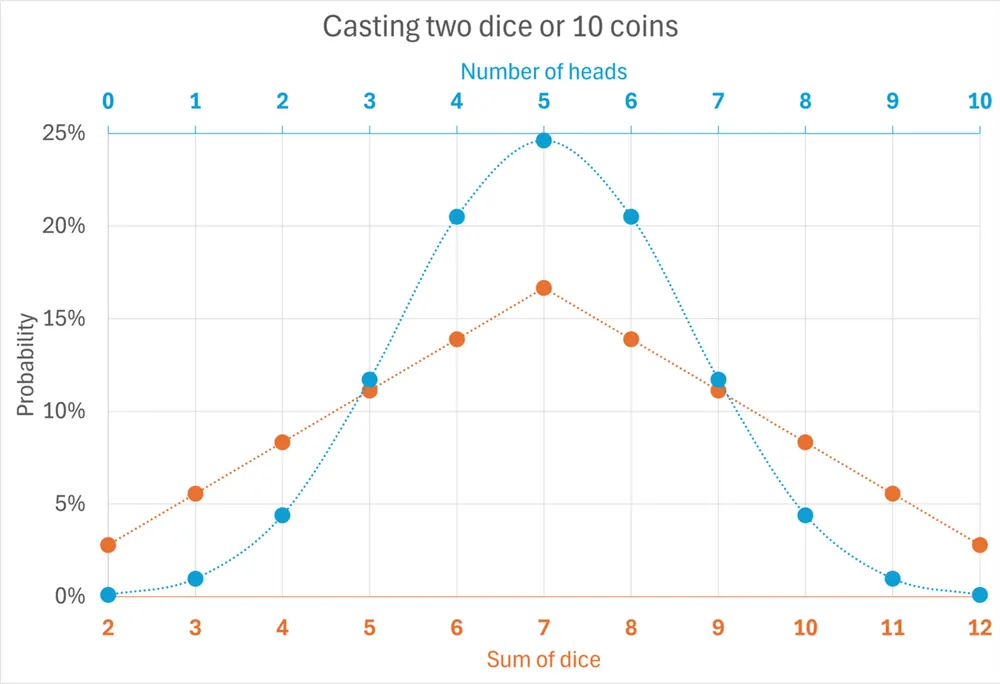
The color game looks like pure luck, and it is, but luck has a shape. With three six-colour dice there are exactly 216 equally likely outcomes, and from those you can work out every probability in the game: how often your colour hits, what betting two colours really does, how long a colour can stay away, and how much the house keeps.
This page is the math reference. For practical tips on stop-win and stop-loss, read our Tagalog paano manalo sa color game guide. For live dealer dice games online, see our live casino Philippines hub.
18+/21+. Crypto only. Ad: we may earn a commission. Play responsibly. October 2026
The setup
The classic perya color game uses three dice (or cubes) with six colours, commonly red, blue, yellow, green, white and pink, though colour sets vary. The dice are rolled down a ramp or tossed, and players bet on colours on a matching board. A standard payout schedule for a colour bet is:
- Colour shows on one die: 1:1
- On two dice: 2:1
- On all three: 3:1
- Doesn't show: you lose the bet
We'll assume fair dice and this schedule unless stated otherwise. Online live versions may use different payouts or multipliers; the method below still works if you plug in their numbers.
One colour: the core probabilities
For any single colour, each die has a 1 in 6 chance of showing it. Across three dice:
| Your colour appears on | Outcomes (of 216) | Probability | Net result on ₱100 |
|---|---|---|---|
| 0 dice | 125 | 57.87% | -₱100 |
| 1 die | 75 | 34.72% | +₱100 |
| 2 dice | 15 | 6.94% | +₱200 |
| 3 dice | 1 | 0.46% | +₱300 |
Where these come from: no match on all three dice is (5/6)³ = 125/216. Exactly one match is 3 × (1/6) × (5/6)² = 75/216. Exactly two is 3 × (1/6)² × (5/6) = 15/216. All three is (1/6)³ = 1/216.
Expected value per ₱100: (75 × 100 + 15 × 200 + 1 × 300 − 125 × 100) ÷ 216 = −₱7.87. So the house edge is 7.87%, and the return to player is 92.13%.
Why it feels like you win more than you do
Your colour shows up 42.13% of the time, close to half. Many players mentally round that to "about 50-50" and assume the game is nearly fair. But when it doesn't show, you lose your whole bet, and when it does, you usually win just even money. The doubles and triples that pay 2:1 and 3:1 are too rare (7.4% combined) to make up the difference.
What happens to all six colours in one roll
Looking at the whole board instead of one colour:
- Three different colours: 120 of 216 outcomes (55.6%).
- One colour twice and another once: 90 outcomes (41.7%).
- One colour on all three dice: 6 outcomes (2.8%).
This explains how the operator always profits from a full board. If every colour has one equal bet, each roll pays out exactly three "hits" worth of winnings in total, while three or more colours lose. When three different colours show, the house collects three losing bets and pays three winning ones: break even. With a double, four colours lose and the house is up. With a triple, five lose. The house never loses on a balanced board.
Betting two or three colours at once
Spreading across colours raises the chance that something hits, but changes nothing about the edge per peso. With equal bets:
| Bet | At least one colour hits | Round ends ahead | Break even | Round ends behind |
|---|---|---|---|---|
| 1 colour | 42.1% | 42.1% | 0% | 57.9% |
| 2 colours | 70.4% | 25.9% | 44.4% | 29.6% |
| 3 colours | 87.5% | 37.5% | 12.5% | 50.0% |
Two colours "hit" 70% of the time, but most of those hits are one colour winning and the other losing, a break-even round. You're actually ahead after the round only about a quarter of the time. Three colours hit 87.5% of the time, yet half of all rounds still leave you behind. In every case, the expected loss is 7.87% of the total amount bet, so more colours means more pesos lost per round on average.
How payout schedules change the edge
Some perya stalls and online versions change the triple payout or add other tweaks. Plugging different numbers into the same formula:
| Payout (1 / 2 / 3 dice) | House edge |
|---|---|
| 1:1 / 2:1 / 3:1 (standard) | 7.87% |
| 1:1 / 2:1 / 4:1 | 7.41% |
| 1:1 / 2:1 / 9:1 | 5.09% |
| 1:1 / 1:1 / 1:1 (pays once however many) | 15.74% |
That last row is a schedule some informal games use, paying even money no matter how many dice match. It doubles the house edge. Always ask how doubles and triples pay before you play.
DIY formula: edge = 1 − (75 × (p1 + 1) + 15 × (p2 + 1) + 1 × (p3 + 1)) ÷ 216, where p1, p2, p3 are the payouts for one, two and three matches.
Droughts: how long can a colour stay away?
Each roll, your colour misses with probability 57.87%. The chance it misses several rolls in a row from any starting point:
| Consecutive misses | Probability | About 1 in |
|---|---|---|
| 5 | 6.5% | 15 |
| 8 | 1.3% | 79 |
| 10 | 0.42% | 237 |
| 15 | 0.027% | 3,657 |
These look rare, but you face them over and over. In a 100-round session, the chance that your colour goes at least 8 rolls without appearing at some point is about 41%, based on our simulation of 20,000 sessions. In other words, a long drought is a normal part of an evening, not a sign that the colour is "due." The next roll is still 42.13%, whatever happened before.
Streaks the other way
Your colour appearing several rolls in a row is less common, since each hit is 42.13%. Three in a row: about 7.5%. Five in a row: about 1.3%. When people see a colour hit five times, they often pile on, believing it's hot. The sixth roll is still 42.13%.
18+/21+. Crypto only. Ad: we may earn a commission. Play responsibly. October 2026
What 100 rounds look like
Betting one colour, ₱20 per round, for 100 rounds (₱2,000 total wagered):
- Expected hits: about 42 rounds with at least one match; about 35 single matches, 7 doubles, and roughly a 37% chance of at least one triple.
- Expected result: about −₱157.
- Share of sessions ending ahead: roughly a quarter, from our simulations of single-colour betting over 100 rounds.
Shorter sessions give luck more room; longer ones pull results toward the edge. That's why the practical advice is short sessions with firm limits.
Spotting an unfair game
Informal perya games aren't regulated, and loaded dice or a biased ramp can shift the odds. You can't prove anything from a few rolls, but some signs are worth noticing:
- Colour counts far from expected over many rolls. Over 100 rolls (300 dice faces), each colour should appear about 50 times. Counts in roughly the 38 to 62 range are normal variation. A colour showing 25 or 75 times is a strong warning sign.
- Heavily bet colours almost never appearing. If the most popular colours keep missing while unbet colours hit, be suspicious.
- Dice handled or swapped out of view. Fair games keep the dice visible.
- Unclear or changing payouts. A legitimate game posts its payouts.
If something feels off, don't stay to test it. Walk away.
Color game vs sic bo single numbers
Mathematically, a colour bet with 1/2/3 payouts is identical to a single-number bet in sic bo: same 216 outcomes, same 7.87% edge. The difference is in the setting. Licensed casinos use precision dice and automatic shakers; perya games may not. Sic bo also offers Big/Small at 2.78%, a much cheaper bet than anything on a colour board. Our sic bo strategy cheat sheet ranks every bet.
Quick reference card
- Chance your colour shows at least once: 42.13% (about 3 in 7).
- Chance of exactly one, two, three matches: 34.72%, 6.94%, 0.46%.
- House edge at 1/2/3 payouts: 7.87%. At even money regardless of matches: 15.74%.
- Expected loss per ₱1,000 wagered: about ₱79.
- Chance of a 5-roll drought from any point: 6.5%.
- All three dice the same colour: 2.78% of rolls.
- Over 100 rolls, each colour should appear about 50 times across the 300 dice faces.
Common probability mistakes
- "Three dice, so a 50% chance." It's 42.13%, and that's for any match at all.
- "Two colours cover a third of the board, so I'll win a third of the time." You'll be ahead about 26% of the time and behind about 30%.
- "It hasn't come for ten rolls, so it's due." The dice don't track history.
- "Doubles and triples make up for the losses." They're 7.4% of outcomes combined; not enough.
Why probability doesn't predict your night
Probabilities describe what happens over many rolls, not the next few. A 42% event can miss eight times in a row; a 0.46% triple can show up twice in one evening. The edge is certain only in the long run, which is exactly why short sessions are where wins happen and long sessions are where the house collects. Use the numbers to choose sensible bets and budgets, not to forecast the next roll.
Taglish recap
Sa bawat roll, mga 42% ang tsansang lumabas ang kulay mo, pero 7.87% ang kinukuha ng bahay sa katagalan. Mas maraming kulay ang tayaan, mas madalas may tama pero mas malaki rin ang kabuuang taya at pareho ang edge. Normal ang mahahabang drought; hindi ibig sabihin na "due" na ang kulay. Itanong muna ang bayad sa doubles at triples bago maglaro.
Online color games
Live studios now run color-game-style shows with physical dice and a host, often adding random multipliers to some colours or results. To fund those, base payouts are usually reduced. Use the formula above with the base payouts, then remember multipliers add a little back on average. The game's info panel should state its RTP; compare it with the 92.13% of the standard perya schedule. Offshore crypto casinos such as Cloudbet offer live dice games to Filipino players; Cloudbet is licensed in Curaçao, not by PAGCOR, so there's no local regulator for disputes.
Legal and responsible play
Only adults 21 and over may gamble in the Philippines, and PAGCOR bars students and government employees. Most perya colour games are informal and unlicensed, which means no protection if a game is rigged. Treat the colour game as paid entertainment with a fixed budget, and keep children away from the betting board, even at the perya.
Mga Madalas Itanong (FAQ)
Ano ang tsansang lumabas ang kulay ko sa color game?
Mga 42.13% na lalabas ito sa kahit isang dice sa bawat roll.
Ano ang house edge ng color game?
Mga 7.87% sa karaniwang bayad na 1:1, 2:1 at 3:1.
Mas maganda ba ang pagtaya sa dalawang kulay?
Mas madalas may tama, pero mga 26% lang ng rounds na nauuna ka at pareho ang edge kada piso.
Normal ba na hindi lumabas ang kulay ko nang sampung beses?
Bihira pero nangyayari; sa 100 rounds, mga 41% ang tsansang may 8-round drought kahit saan.
PAGCOR-licensed ba ang Cloudbet?
Hindi, Curaçao ang lisensya ng Cloudbet.
18+/21+. Crypto only. Ad: we may earn a commission. Play responsibly. October 2026
18+/21+. Crypto only. Ad: we may earn a commission. Play responsibly. October 2026
If gambling stops being fun, call PAGCOR's free 24/7 National Problem Gambling Helpline at (02) 8248-9568 (+63 2 8248 9568), or visit npgh.ph. Source: PAGCOR Responsible Gaming.